ReNformation
Renaissance-Reformation-Enlightenment
2.0
The Exodus Wilderness Tabernacle
This 1:75 scale model of the Wilderness Tabernacle was created by Project314.org. Whether viewed from theological symbolism or architectural theory, the image is striking: a vast, glowing red hemisphere rising in the wilderness, powerful enough to bewilder its enemies.

The Tabernacle of David

Around 1410 BC, in the wilderness of the ancient Near East, imagine the tribes of Israel encamped around a six-story high structure unlike anything the surrounding nations had seen. With an outer circumference of 314 cubits, a 100-cubit diameter, and a 50-cubit radius, it towers between 60 and 80 feet—dominating the landscape.
To the Amorites preparing for battle, this would not resemble anything they had ever seen. Such a monumental, perfectly circular structure gleaming in the sun would project power, order, and divine presence. By firelight at night, the red surface might appear to glow, creating a psychological impact before any sword was drawn.
On this left side we see the traditional box-shaped Tabernacle that has about 750 sq. ft. inside.
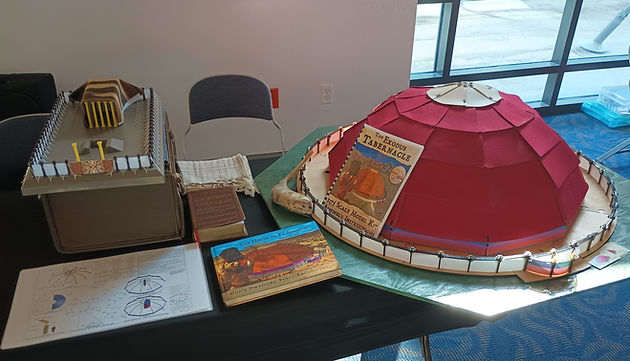
On this right side we see the dome-shaped Tabernacle that has an estimated 13,000 sq. ft. inside
Hello, the Wilderness Tabernacle structure is envisioned here as a six-story-high, yurt-like tent.
-
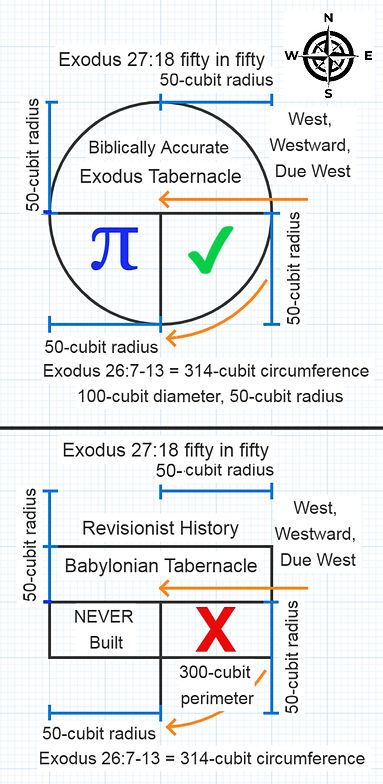
Flavius Josephus is questioned because his “50 cubits wide and 100 cubits long” description treats the Tabernacle courtyard as a rectangle, while Exodus 26:7–13 can be read as a sequential pattern forming a circular layout: a 314‑cubit (π‑based) circumference, a 50‑cubit radius, and a 100‑cubit diameter. In that reading, “length” and “width” function as diameter and radius, not rectangular dimensions.
-
Beginning with the first “pattern” instructions in Exodus 26:1–6, the curtains are described as joining from one end (מִקָּצָה) to the outermost edge (הַקִּיצוֹנָה), connected by four-cubit ends with loops of blue.
Moses' building instructions start in Exodus 26:1-6, which Exodus 26 & 27 must accommodate.
Each curtain has four edges:
1. Two edges with blue loops are at the 4-cubit cut "edge, end, outermost" (Exodus 26:4).
2. Two edges are the 28-cubit uncut edges.
In loom-weaving language the warp is at the 4-cubit cut "edge, end, outermost," while the selvedge is at the 28-cubit uncut edge.
Young's Literal Translation ✅✅ Wilderness Tabernacle Ex. 26:4 `And thou hast made loops of blue end-to-end, outermost, warp
upon the edge of the one curtain, at the -END- in the joining;
English Standard Version ✅ ?
Ex. 26:4 And you shall make loops of blue on the edge of the -OUTERMOST-
curtain in the first set.
Ex. 26:4 You shall make loops of blue on the edge of the one curtain from the -EDGE-
in the coupling;
Douay-Rheims Catholic Bible ❌ ?
Ex. 26:4 Thou shalt make loops of violet in the -SIDES-
King James Version ❌❌
Ex. 26:4 And thou shalt make loops of blue upon the edge of the one
curtain from the -SELVEDGE- in the coupling;
miq·qā·ṣāh = END
Quiz
On Mt. Sinai in 1440 BC, Moses was given the first approximation of Pi within .05% in history!
Exodus 26:7-13
A) Pi from Exodus 26:7-13
330 cubits long = Ex. 26:8 Eleven curtains each 30 cubits long by 4 cubits
315 cubits long = Ex. 26:9 One curtain is folded in half to 15 cubits long
314 cubits long = Ex. 26:13 Curtain hang over taken in 1 cubit long
330 - 15 - 1 = 314-cubit circumference circle
&
B) Pi from Exodus 27:18
3.14 = 314 circumference/50-cubit radius, "50 in 50," c = 2 π r
&
C) Pi from Exodus 38:13
c = 2 π r
Pi is woven together in the spiral of the double helix in your DNA. The relationship between Pi (approx. 3.14159), Phi (approx. 1.618), and a dome lies in the intersection of ancient architecture and structural efficiency. While Pi deals with curvature and circles, and Phi with proportion and growth, they combine to form stable, aesthetically pleasing dome structures. 2,000 years ago, everyone accepted Josephus Flavius' wrong Tabernacle description into our religious dogma. They all come from the same bad data; Josephus the historian's history is not holy canon, friend.
Sometimes, width is just width; in others, it is radius; and in one instance, it is diameter... it depends on the CONTEXT.
Exodus 26:14
"and thou hast made a covering for the tent, of rams' skins
made red, and a covering of ❌badgers'❌ skins above."
-
Martin Luther wrongly interpreted the word תְּחָשִׁ֖ים
into "badgers," which are unclean, non-kosher animals
like pigs.
-
LUTHER's translation was based on the notion that the
German word "Dachs" (badger) was phonetically and/or
morphologically related to the Hebrew word "tachash.
-
LUTHER WAS WRONG.
-
The Holy of Holies would NOT be covered by unclean animal skins. In 168 BC the Greeks captured Jerusalem and marched into the Jewish temple and sacrificed a pig on the Altar of Incense.
-
How to measure the tent's surface area for its covering.
The blueprints from Exodus 26:15-37 continue the construction instructions for the Wilderness Tabernacle.
It's a Jewish wedding tradition for the bride to circle the groom, a ritual known as hakafot, הַקָּפוֹת which symbolizes several things including creating a new home, building a protective "wall" around the groom, and the start of a new life together. The bride typically circles the groom seven times, a number with deep significance in Judaism that represents completion and perfection.
Exodus 27:9-21
9 `And thou hast made the court of the tabernacle: for the south side/to edge southward, hangings
for the court of twined linen, a hundred by the cubit [is] the length for the one side/edge,
10 and its twenty pillars and their twenty sockets [are] of brass, the pegs of the pillars and
their fillets [are] of silver;
11 and so for the north side/edge in length, hangings of a hundred [cubits] in length, and its
twenty pillars and their twenty sockets [are] of brass, the pegs of the pillars and their fillets
[are] of silver.
12 `And [for] the breadth of the court at the west side/edge [are] hangings of fifty cubits, their
pillars ten, and their sockets ten.
13 And [for] the breadth of the court at the east side/to edge, eastward, [are] fifty cubits.
14 And the hangings at the side/shoulder [are] fifteen cubits, their pillars three, and their sockets three.
15 And at the second side/shoulder [are] hangings fifteen [cubits], their pillars three, and their sockets three.
16 `And for the gate of the court a covering of twenty cubits, blue, and purple, and scarlet, and
twined linen, work of an embroiderer; their pillars four, their sockets four.
Josephus Flavius 37-100 AD
Curtain loops join together
at uncut edges, the
"selvedge." ❌
Exodus 26:1-6
Est. 750 sq. ft.
Josephus' Historic Mistakes
In "Antiquities of the Jews," Volume 1, Book 3, Chapter 6, Josephus Flavius begins his construction instructions from Exodus 26:30, skipping over Exodus 26:1-29, and then moves on to Exodus 27:18, skipping over Exodus 26:31 and 27:1-17. Then he works his way backwards, describing nearly everything out of context. He misinterprets Exodus 27:18 by conflating Herod's Temple with the Wilderness Tabernacle, incorrectly calling it a "quadrangular figure." However, this rectangular courtyard violates Exodus 26:7-13 314-cubit circumference circle. Exodus 27:18 "the breadth is 50 by 50 (KJV "50 everywhere"), and the height 5 cubits." The 50-cubit courtyard radius is established in Exodus 26:7-13 and confirmed in Exodus 38:9-13.
-
"Antiquities of the Jews"
94 AD by Josephus Flavius
"Moses...he had measured the open
court, 50 cubits wide and a 100 long."❌
context context context
1440 BC - Moses is given the "pattern"
of the Wilderness Tabernacle on Mt. Sinai
1406 BC - Moses dies & Hebrews enter
the Promised Land
1010 BC - King Saul of Israel
957 BC - Solomon's Temple finished
931 BC - Israel splits into two kingdoms
720 BC - Northern Kingdom destroyed
586 BC - Southern Kingdom destroyed
420 BC - The intertestamental period
3 BC - Christ born
30 AD - Christ crucified & resurrected
30 AD - Pentecost
70 AD/3830 - Second Temple destroyed
325 AD - Constantine's Council of Nicaea
1517 AD - Reformation begins
1947 AD - Dead Sea Scrolls discovered 2014AD - Wilderness Tabernacle
blueprints discovered in the Exodus text
by Project314.org
correct placement, correct word


_edited.jpg)
Exodus 26:1-6
1 `And thou dost make the tabernacle: ten curtains of twined linen, and blue, and purple, and scarlet; [with] cherubs, work of a designer, thou dost make them;
-
10 blue, purple & red linen curtains with cherubim sewn on that make the Tabernacle
2 the length of the one curtain [is] eight and twenty by the cubit, and the breadth of the one curtain four by the cubit, one measure [is] to all the curtains;
-
10 curtains are 28 by 4 cubits
3 five of the curtains are joining one unto another, and five curtains are joining one to another.
-
10 curtains are divided into two sets of 5 curtains to be coupled
4 `And thou hast made LOOPS OF BLUE upon the EDGE of the one curtain, at the END in the joining; and so thou makest in the EDGE of the OUTERMOST curtain, in the joining of the second.
-
The curtains are joined together as one by their 4-cubit EDGE, END, OUTERMOST using the BLUE LOOPS, NOT red loops.
-
4-cubit EDGE-END מִקָּצָ֖ה
-
4-cubit EDGE-OUTERMOST הַקִּ֣יצוֹנָ֔ה
-
NOT the 28-cubit edges
-
4-cubit end-to-end curtains look like these lines
---------------------------
-
The box Tabernacle curtains join the 28-cubit side-by- side and look like these lines |||||||||||||||||||||||||||||||||||||
-
See the difference?
-
And gives us the curtain color "pattern" Ex. 25:40
5 fifty loops thou dost make in the one curtain, and fifty loops thou dost make in the edge of the curtain which [is] in the joining of the second, causing the loops to take hold one unto another;
-
50 loops at each end בִּקְצֵ֣ה of each curtain join together to be one with another curtain's 50 loops
6 and thou hast made fifty hooks of gold and hast joined the curtains one to another by the hooks, and the tabernacle hath been one.
-
50 gold hooks finish the joining the curtains together to become one makes the Tabernacle
_edited_edited_edited.jpg)
_edited_edited.jpg)
_edited_edited_edited_edited_edited_edited_edited.jpg)
_edited_edited_edited_edited_edited_edited_edited.jpg)
_edited_edited_edited_edited_edited_edited_edited.jpg)
_edited_edited_edited.jpg)
_edited_edited.jpg)


?
?
_edited_edited_edited_edited_edited.png)
Quiz: Exodus 26:1–6 and the Tabernacle Curtains
-
Were the Exodus 26:1–6 curtains connected with gold or silver hooks?
A. Gold
B. Silver -
What is the best translation for מִקָּצָה?
A. From side
B. From edge
C. From end
D. From selvedge -
What term refers to the set of long, parallel threads that run lengthwise on a loom, forming the foundation and structure stretched taut between the loom beams?
A. Warp
B. Selvedge -
The Exodus 26:1–6 curtains are first divided into two sets of five and then joined back together as one unit.
A. True
B. False -
How many of the ten-curtain blue-loop ends in Exodus 26:1–6 join together with the loops of the other set?
A. Zero
B. Nine
C. Ten
D. Eight -
The loom’s warp threads are cut off at the ends when the weaving is finished.
A. True
B. False -
What structural design is generally best for a camping tent?
A. A box tent
B. A dome tent -
Which statement is accurate according to Exodus 26:1–6?
A. The individual curtains measure 4 cubits by 30 cubits.
B. The individual curtains measure 4 cubits by 28 cubits. -
The Exodus 26:1–6 curtains are described as blue, purple, and green.
A. True
B. False -
Each curtain in Exodus 26:1–6 has four edges: two uncut 28-cubit edges (selvedges) and two 4-cubit cut ends (warp ends).
A. True
B. False -
Which passage starts the sequential “pattern” referenced in Exodus 25:9, 40?
A. Exodus 26:1–6
B. Exodus 27:18
1. A. 2. C. 3. A. 4. A. 5. C. 6. A. 7. A. 8. B. 9. A. 10. B. 11. A 12. A.

Exodus 26:4a
מִקָּצָ֖ה = from end ✅
מִקָּצָ֖ה = selvedge ❌
Selvedge is a textile term for the tightly woven edge of fabric that
prevents unraveling and fraying; it's NOT a synonym for "end."
End & Selvedge are not ambiguous or interchangeable.
Exodus 25:19
KJV: one cherub on the one ✅END✅, and the other cherub on the other ✅END✅
YLT: one cherub at the ✅END✅ on this side, and one cherub at the ✅END✅
NASB: one cherub at the ✅END✅ on this side, and one cherub at the ✅END✅
Exodus 26:4
KJV: curtain from the ❌SELVEDGE❌ in the coupling
YLT: at the ✅END✅ in the joining
NASB: [f]outermost curtain in the first set, and likewise ✅from the end✅
Exodus 36:11
KJV: curtain from the ❌SELVEDGE❌ in the coupling
NASB: of the [ac]outermost curtain in the first one curtain ✅from the end✅
Exodus 37:8
KJV: One cherub on the ✅END✅ on this side, and another cherub on the other ✅END✅
YLT: one cherub at the ✅END✅ on this [side], and one cherub at the ✅END✅
NASB: one cherub at the one ✅END✅ and one cherub at the other ✅END✅
Why is this textile word, SELVEDGE, only used here and here??? It's NOT the
Hebrew word!


_edited_edited_edited.jpg)

Exodus 27:17-19
17 All the pillars of the court round about [are] filleted [with] silver,
their pegs [are] silver, and their sockets brass.
18 `The length of the court [is] a hundred by the cubit, the breadth is 50 by 50 (KJV "50 everywhere"), and the height 5 cubits.", of twined linen, and their sockets [are] brass,
19 even all the vessels of the tabernacle, in all its service, and all its pins, and all the pins of the court, [are] brass.
Exodus 27:20–21
Statues were presented for Israel's future generations,
and olive oil was provided to keep the candles burning overnight.
_edited_edited.png)


Condensation from the "cloud by day" (Exodus 13:21) on the dome can collect water from above.
However, condensation in the rectangle Tabernacle causes mildew, which is unclean (Leviticus 14).
The dome-shaped Tabernacle could be taken down in 4 hours with approximately 2500 to 3500 trained Levites. The much larger dome-shaped Tabernacle only weighs about 1/3 of the box-shaped Tabernacle.
Please remember the silver weight limit from Exodus 38:27.


correct placement, not the perfect word
too ambiguous, what edges?
not the perfect word
too ambiguous, what sides?
not the perfect word
wrong placement,
wrong word


Est. 13,000 sq. ft.
Exodus 26 Side Rib
1. צֵלָע, tsêlâa rib (as curved), literally (of the body)
Adam's rib and the construction of the tabernacle, the word "tsela" is used to describe the sides/rib of the structure. Daniel 7:5, the second beast is described as having "three rib in its mouth between its teeth" among other examples.
Corners Bending
Ex. 26:23-24 מְקֻצְעָה Word Origin: [from H7106 (קָצַע - To end) From qatsa' in the denominative sense of bending

Exodus 26
18 side/rib
20 side/rib, side/rib
22 sides/rib
26 side/rib
27 side/rib, sides/rib
35 side/rib, side/rib
23 corners
24 two corners, head unto the one ring

Side To Edge
"to edge south (and) towards the right"
לִמְקֻצְעֹ֖ת
Yes, תֵּמָן (Tēman) in Biblical Hebrew means "South" or "to the right," derived from the root meaning "right hand," because facing east (the rising sun).
side/to edge
side/to edge


KJV 50 everywhere

Exodus 26:10 "Outermost"
שְׂפַ֤ת - edge
הַקִּיצֹנָ֖ה - OUTERMOST
שְׂפַ֣ת - edge

4-cubit

Exodus 26:4 - 4-cubit
שְׂפַ֤ת - edge
מִקָּצָ֖ה - edge END
בִּשְׂפַ֣ת - edge
הַקִּ֣יצוֹנָ֔ה -edge OUTERMOST
4-cubit
Exodus 27:18
"width 50 in/by 50" or "width 50 tenting 50," 50 wide from the center is radius
ורחב חמשים בחמשים
"And fifty by fifty wide"
50-cubit radius
H7341 "expanse," root: H7337 רָחַב which means to be or grow wide, (50 by 50 ) expanse
H7572 בַּחֲמִשִּׁים "by/in/with fifty," plural form "by fifties," 50 by 50-cubit radius
NASB
Ex. 27:18 "...width 50 throughout..."
KJV, ASV
Ex. 27:18 "...breadth 50 everywhere..."
The Tabernacle's 314-cubit circumference (Ex.26:7-13) of Pi π has a 50-cubit radius and a 100-cubit diameter. See the mistake? It's NOT a 100 cubits long & 50 cubits wide rectangle.


Summarized in one sentence.
The Tabernacle's curtains are joined together as one by their loops of BLUE 4-cubit "edge, end, outermost" (Ex. 26:4), NOT their loops of RED 28-cubit edges.
Skipping over Exodus 26:4 is a procedural error that breaks the Tabernacle's sequential building "pattern" that we are told twice to follow (Exodus 25:9, 40). Later backtracking led to twisting Exodus 26:4 into an eisegetical mess, but now that time is over.
A 1st Temple mindset understands "foursquare" as 4 equal parts, width quartered or quartered.
"Width quartered"
Exodus 27:1-8 Hebrew description does not convey such redun-dancy, it does refer to the altar as רחב רבוע or "width quar-tered" (H7341, H7251). A cylindrical or semi-spherical altar would allow for best airflow and heating (unlike a square altar with right angle corners) quartered instead of square.

"Length" & "width" are "diameter."

This is one of the ten curtains described in Exodus 26:1–6. Each curtain measures 28 cubits long (about 42 feet) and 4 cubits wide (about 6 feet), using an 18-inch cubit. They were long, narrow loom-woven linen joined together as one.
The “loops of blue” are placed at the top 1/3 of the 4-cubit ends—the shorter sides. When the curtains stand upright to form the tent wall.
4-cubit
Josephus' Tabernacle curtains/roof edge selvedge
A song about the Loops of Blue from Exodus 26:4.
When these ten equal curtains are joined end to end, a ten-sided shape known as a decagon is created.
Ten sides = decagon.

Taking a word or phrase out of context is called "contextomy" or biblically "eisegesis." Eisegesis means interpreting a biblical text by reading your own ideas or biases into it, essentially ignoring the original context and intended meaning.
How do ye say, We [are] wise, And the law of Jehovah [is] with us? Surely, lo, falsely it hath wrought, The false pen of scribes. Jeremiah 8:8

Both Tabernacle models were misrepresented by GORK, A.I. How would our hermeneutic Profs feel about applying A.I. in this way? The "loops of blue" mentioned in Exodus 26 were not addressed by GORK. What's the reason? GORK merely repeated online religious traditions without using Hebrew or CONTEXT.
"I asked Grok for an analysis, and I think it does an even better job."
- Doug Overmyer
Was the Tabernacle Dome-Shaped? Debunking the Round Temple Theory

Here is a rephrasing of Exodus 26:4:
Make loops of blue along the edge of one curtain, specifically at the end where it will connect to another curtain. These loops are to be placed on the outer edge of the curtain at the joining point. In the same way, you must also make loos of blue along the corresponding edge of the outermost curtain in the second set, at the place where the two sections will be joined together as one.

Project314.org created professionally rendered blueprints and a 1:75 scale model of the Wilderness Tabernacle, which Andrew L. Hoy discovered in the Exodus text in 2014.

_edited.jpg)
-Photoroom_edited_edited_edited_edited_edited.png)


Ancient Hebrew Research Center
The Tabernacle: An Ancient Journey with the Ancient Hebrew Language | AHRC
The Christian Times
Tabernacle in Bible was circular not rectangular, says Bible-loving engineer | Christian Times
Summarized in one sentence.
The Tabernacle's curtains are joined together as one by their loops of BLUE 4-cubit "edge, end, outermost" (Ex. 26:4), NOT their loops of RED 28-cubit edges.
_edited_edited.jpg)


Ezra 3:12
And many of the priests, and the Levites, and the heads of the fathers, the aged men who had seen the first house -- in this house being founded before their eyes -- are weeping with a loud voice, and many with a shout, in joy, lifting up the voice;
Haggai 2:3
‘Who is left among you who saw this house in its former glory? How do you see it now? Is it not as nothing in your eyes?

The Third Temple

Why does the current Third Temple structure look like the Second Temple, which was patterned after Babylonian architecture like the Ishtar Gate?
Solomon's Temple
Hello, my name is Hayden Hendrix, and the blueprint on the left represents my current, incomplete, and imperfect theory about Solomon's Temple. The hand drawn blueprint came from a friend and differs from mine. Please email me if you want to help create an accurate blueprint of Solomon's Temple.
Thank you for visiting my site.


Isaac Newton's studies on Solomon's Temple focused on its sacred geometry and dimensions. He noted that the temple's measurements, as described in the Bible, posed mathematical challenges related to concepts like Pi and the volume of a hemisphere.
Why was Isaac Newton wrong about Solomon's Temple being box-shaped like the Ishtar Gate from Babylonian? Because Newton based his research on what Josephus Flavius wrote in Antiquities of the Jews (93 AD). Josephus the historian's history is not holy canon, friend.
Noah's Ark
-
Where were they going?
-
Is it possible we missed that "length" and "width" are interchangeable with "diameter" and "radius" based on the context?
-
In an ocean storm, what shape would be best for Noah's Ark since it had no propulsion, sails, rudder, wind vanes, ballast, or any other controls? "Dead in the Water"
-
Noah's Ark has only one window; how would that look?
-
Would you send me an illustration of the biblically accurate Noah's Ark?
-
How is the word "ark" different from "ship" and "boat"?
-
What if this enclosed system had a perfect ecosystem with plants and earth?


This section about Noah's Ark is completely separate from the Tabernacle.
This theory about Noah's Ark came to me in the spring of 2025.
Genesis 6:14-16
14 `Make for thyself an ark of gopher-wood; rooms dost thou make with the ark, and thou hast covered it within and without with cypress;
15 and this [is] that which thou dost with it: three hundred cubits [is] the length of the ark, fifty cubits its breadth, and thirty cubits its height;
16 a window dost thou make for the ark, and unto a cubit thou dost restrain it from above; and the opening of the ark thou dost put in its side,—lower, second, and third [stories] dost thou make it.
_edited_edited.jpg)

_edited_edited_edited_edited.jpg)
.jpg)
Dr. Irving Finkel, British Museum Assyriologist, translated a 3,770-year-old Babylonian tablet (1750 BCE) describing the flood myth with Atra-Hasis (the Babylonian Noah). The tablet gives detailed instructions for building a large, ROUND, coracle-like ark—different from the traditional rectangular Biblical ark. His work was popularized in the book The Ark Before Noah (2014).
The Bible is our authority, and not archeology. However, archeology may offer clues to test.
_edited.jpg)

context context context
_edited_edited.jpg)
One question: if you had to build a "dead in the water" ocean vessel of any shape, what structure would be best, please? This is our context. Me?, I would build a large round Ark that had a deep draft for stability and not a long, narrow cuboid ship. Consider a round Ark for baby Moses floating down the Nile River; what shape is best?
Noah’s Ark & Moses' Ark: Tevah (תֵּבָה)
Moses' Ark


The New Jerusalem
Revelation 21:15 And the one who spoke with me had a measuring rod of gold to measure the city and its gates and walls. 16 The city lies foursquare, its length the same as its width. And he measured the city with his rod, 12,000 stadia. Its length and width and height are equal.


_edited.jpg)


_edited_edited_edited_edited.png)
"Length" and "width" do double duty for "diameter" and "radius" in the proper context.
Linear relationships involve a constant rate of change, plotting as a straight line, while curved (nonlinear or curvilinear) relationships have changing rates of change, appearing as arcs or bends.